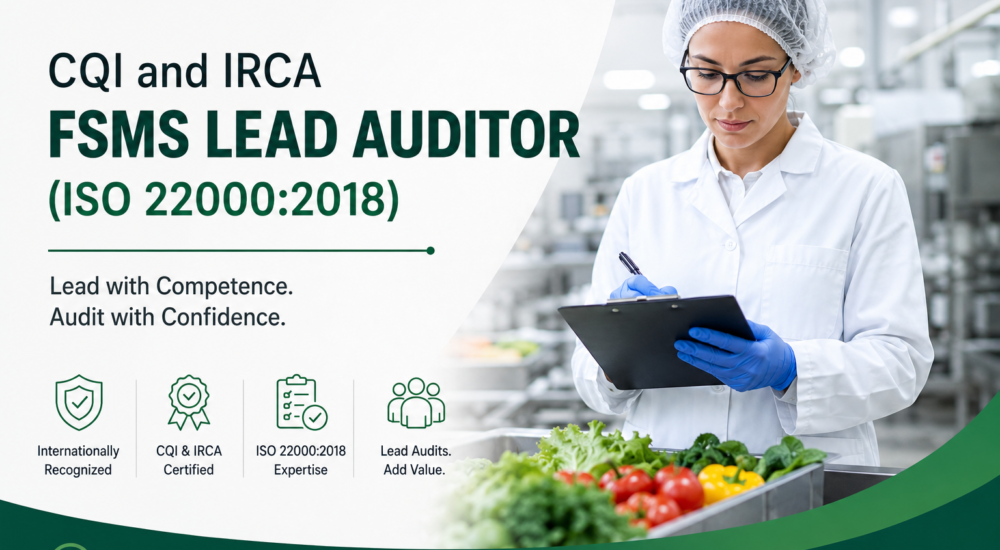
CQI and IRCA FSMS Lead Auditor(ISO 22000:2018)(Ref. No: 2319) 
This course is delivered in association with CQI and IRCA Approved Training Partner TVE International Academy (ATP No. – 6023829)
Why CQl and IRCA?
CQI and IRCA is the leading professional body for management system auditors and offers a globally recognized business qualification. CQl and IRCA represents over 10,000 registered auditors in 150 countries and every year around 60,000 delegates attend CQI and IRCA certified training course. CQI and IRCA Certified courses are recognized as an industry leader and CQI and IRCA endorsement means that you can be confident that the course you are attending:
- Covers the key knowledge and skills you need to start your journey as a management systems auditor
- Will be taught by tutors who are experienced auditors and trainers who have fulfilled CQI and IRCA tutor competency requirements
- Will be taught using a variety of proven practical student- focused learning and enjoy the course
- Has a limited class size to maximize participation and optimize your learning
- Has been regularly assessed by CQl and IRCA approved technical assessor
- Completion of this course is the first step to becoming CQI and IRCA registered, to find out more please visa irca.org/join
CQI and IRCA recognize that attending a training course is usually a major commitment, both in terms of cost and time.
CQI and IRCA only approves organizations that have demonstrated a high standard of technical and training expertise.
When you are choosing CQI and IRCA certified Course and Training Organization you can be certain that :
- Your knowledge and skills are developed through an interactive and practical approach to tasks and audit activities.
- Courses are delivered by tutors who are experts in management systems in auditing and experienced in training.
- Students are formally assessed and examined during training.
Who will benefit?
- FSMS auditors, e.g. those employed by third party certification bodies / registrars, or by purchasing organizations.
- FSMS practitioners, e.g. Food Safety consultants, Food Safety managers and other Food Safety personnel.
- Employees conducting Food Safety Management System audits within their own organization i.e. Internal Standards
Learning Objectives:
Learning objectives describe in outline what students will know and be able to do by the end of the course. On completion, successful students will have the knowledge and skills to:
Knowledge
Describe the purpose of a Food Safety Management System, of Food Safety Management Systems standards, of management system audit and of third-party certification Explain the role of an auditor to plan, conduct, report and follow up a Food Safety Management System audit in accordance with ISO 19011 (and ISO 22003 including ISO 17021 where appropriate).
Skills
Plan, conduct, report and follow up an audit of a Food Safety management system to establish conformity (or otherwise) with ISO 22000 or acceptable equivalent and in accordance with ISO 19011 (and ISO 22003 including ISO 17021where appropriate).
Course Format
- Course Program
- Each day is divided into four sessions, two before lunch and two after lunch.
- The first session precedes the mid-morning break and the second follows midmorning break.
- The afternoon sessions are similarly divided.
- The output of the exercise are a part of the formal continuous assessment and will therefore be marked.
- Although the exercises are group exercises individual score to the delegate will participation.
- A mock audit – Role play will be conducted on Days 4 & 5 of the Training for the delegates to demonstrate the skill s learned and understood during the course.
- All sessions are interactive and delegate participation is encouraged.
- You will need to allow sufficient time to read and understand the notes which have been provided.
Course Style
- All sessions are delegate interactive and delegate participation is encouraged. Delivery will presentations by lecture, overhead and slide projection.
- There are numerous exercises and each activity is assessed as part of the overall candidature evaluation.
- A model factory will be used and wherever possible practical illustrations will be given. All course presenters will have experience of FSMS design and implementation, and have some experience of FSMS certification and assessment.
- A live audit in a host organization (or an audit role play) will take pl may demonstrates the skills learned and developed during the course
Expected Prior knowledge
Before starting the course, you must inform the students that they are expected to have a prior knowledge.
Knowledge of the following Food Safety Management Principles and Concepts:
- Implementing or operating a management system within a food sector context. This includes private schemes such as BRC, GLOBALGAP, FSSC and/or other schemes which include management system components.
- Relevant key food safety legislation (this may be specific to studentsʼ food industry context and location).
- Knowledge of prerequisite programmes as specified in ISO/TS 22002-1.
- Good Practice guides for Agriculture (GAP), Veterinary (GVP), Manufacturing (GMP), Hygiene (GHP), Production (GPP), Distribution (GDP) and/or Trading(GTP) depending on the segment of the food chain in which the student operates.
- The principles of HACCP as defined by the Codex Alimentarius Commission.
Highlights
- Training Programs are handled by Highly Experienced and CQI and IRCA Qualified Lead Auditors.
- The Batches once committed will not be cancelled
- 3 Fully Equipped Training Halls available Multi Program at the same time.
Course Period
Classroom Training – 5 Days (40 Hours)
Virtual Training – 6 Days (40 Hours)
Exam
There is a 1 Hour and 45 Minutes Open Book – Online exam conducted by CQI and IRCA.
An additional 30-minute grace period will be given to candidates whose native language is not English.
Contact Us For More Info
National Certification Bureau
HSE Training & Consultancy
Munira Tower, Makkah Street 107
Building No. 18, 6th Floor, Office No. 17
Fahaheel, Kuwait – 63007
Phone: +965 6709 7786
Email: info@ncbme.com
Website: www.ncbme.com
Location: View on Google Maps