

Call Us: +965 67097786
Email: info@ncbme.com

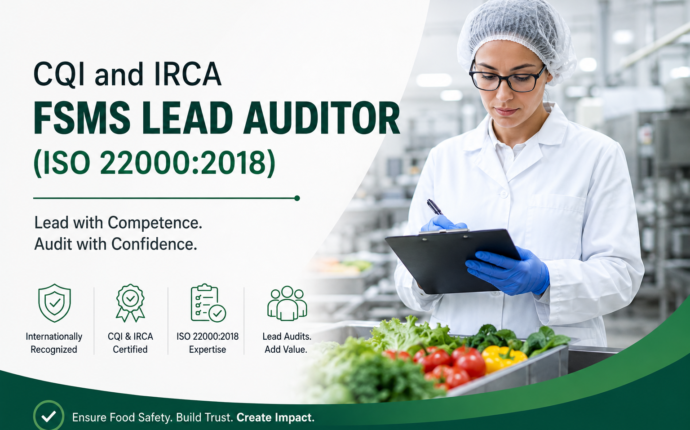
CQI and IRCA is the leading professional body for management system auditors and offers a globally recognized business qualification.
CQI and IRCA represents over 10,000 registered auditors in 150 countries and every year, around 60,000 delegates attend CQI and IRCA certified training course.
CQI and IRCA Certified courses are recognized as an industry leader and CQI and IRCA endorsement means that you can be confident that the course you are attending:
Completion of this course is the first step to becoming CQI and IRCA registered, to find out more please visit www.irca.org/join
· Improves the quality of food and food packaging products
· Improves food safety processes by reducing hazard and incident risk
· Optimizes resources resulting in reduced costs
· Helps prove your products and services are safe, high quality, and reliable
· Builds trust in the supply chain
· Ensures production of food products with prerequisite programs
· Helps facilities enter new markets and establish new customer relationships
· Simplifies food safety plans and programs Given these benefits, it should come as no surprise that
· such a certification enhances reputation, which can bring in new customers and increase bottom lines.
· The additional food loss and waste requirements support a silobreaking approach contributing towards the UN Sustainable development goals (SDGs).
· SDG Target 12.3 on Food loss and waste aims to halve per capita global food waste by 2030
· Incorporates quality control parameters and food safety & quality culture into the Scheme.
· Enhanced measures to aid in certiöcate authenticity, such as the addition of a QR code to each certiöcate.
· The Scheme now includes category FII for trading and brokering.
· Further detail has been added in the Scheme document to aid in better
Management systems – Plan, Do, Check, Act (PDCA) cycle
The core elements of a management system and the interrelationship between top management
responsibility, policy, objectives, planning, implementation, measurement, review, and continual
improvement.
· A knowledge of the principles of food safety management including prerequisite programmes as specified in ISO/TS 22002-x series and HACCP.
· The relationship between food safety management and the provision of safe food products to prevent or minimize adverse effects on human health and the proactive improvement of food safety performance.
· Awareness of common examples of relevant national and local FSMS legislation and requirements
· The role of ISO 22003-1 in food management system certification
· Awareness of the food chain categories and sub-categories in ISO 22003-1.
Note: a) and b) can be obtained through attending a CQI and IRCA Certified FD128 ISO 22000ۉ2018
Virtual training – 5 days (40 hours)
There is a 1 Hour and 45 Minutes Open Book – Online exam conducted by CQI and IRCA. An additional 30-minute grace period will be given to candidates whose native language is not English.