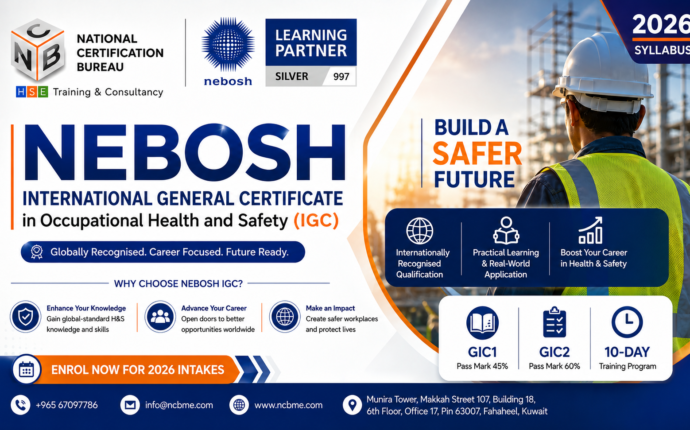





The NEBOSH International General Certificate in Occupational Health and Safety (IGC) provides a comprehensive understanding of workplace health and safety principles. It is ideal for individuals responsible for managing day-to-day workplace risks and is applicable across all industries and organisations worldwide.
For those pursuing a career in occupational health and safety, the IGC is a highly respected qualification recognised by employers internationally. It provides a strong foundation in health and safety management, best practices, and risk control measures, while supporting progression to higher-level professional qualifications.
| Education Level | RQF Level 3 (equivalent to A-Levels in the UK) |
| Study Hours | 103 hours of study + Assessment |
| Training Duration | 10 Days (65 hours) + Assessment |
| NCB eLearning Access Period | 12 months |
| NEBOSH Completion Period | 5 years from first assessment |
| Availability | Worldwide – Classroom, Live Online, E-Learning |
The NEBOSH IGC is based on international standards and best practice. It comprises two units that must be successfully completed within five years.
There are no formal entry requirements for this qualification. However, learners must have a suitable standard of English. NEBOSH recommends a minimum equivalent to an IELTS score of 6.0 or higher.
| Unit | Method | Requirement |
|---|---|---|
| GIC1 | Scenario-based open-book assessment (at home) 24 hours to complete and submit |
Overall grade based on GIC1 score |
| GIC2 | Practical risk assessment in your workplace or another suitable workplace |
Minimum 60/100 marks to pass |
| Grade | Marks Required |
|---|---|
| Distinction | 75 marks or above |
| Credit | 65 – 74 marks |
| Pass | 45 – 64 marks |
You may choose to resit the GIC1 assessment to improve your final grade, even if you have already passed.
| Study Mode | Approximate Fee (KD) |
|---|---|
| Training Centre Attendance | 450 KD |
| Live Online | 225 KD |
| E-Learning | 200 KD |
| Online Course (Starting From) | 200 KD |
| NEBOSH IGC Re-sit Exam Fee | 90 KD |
Training runs from the 20th to 30th of each month. GIC1 digital assessment: learners have 24 hours to access, complete and submit, starting from 11am UK time on the exam date.
| Training Period | Exam Date (GIC1) | Language | Results Date |
|---|---|---|---|
| 20–30 May 2026 | 03 June 2026 | All languages | 26 Aug 2026 |
| 20–30 June 2026 | 08 July 2026 | English only | 01 Oct 2026 |
| 20–30 July 2026 | 05 Aug 2026 | English only | 29 Oct 2026 |
| 20–30 Aug 2026 | 09 Sep 2026 | All languages | 18 Nov 2026 |
| 20–30 Oct 2026 | 07 Oct 2026 | English only | 16 Dec 2026 |
| 20–30 Nov 2026 | 04 Nov 2026 | English only | 21 Jan 2027 |
| 20–30 Dec 2026 | 02 Dec 2026 | All languages | 04 Mar 2027 |
| Submission Deadline | Language | Results Date |
|---|---|---|
| 18 March 2026 | All languages | 02 June 2026 |
| 22 April 2026 | English only | 03 July 2026 |
| 20 May 2026 | English only | 30 July 2026 |
| 17 June 2026 | All languages | 26 Aug 2026 |
| 22 July 2026 | English only | 01 Oct 2026 |
| 19 Aug 2026 | English only | 29 Oct 2026 |
| 23 Sep 2026 | All languages | 02 Dec 2026 |
| 21 Oct 2026 | English only | 07 Jan 2027 |
| 18 Nov 2026 | English only | 04 Feb 2027 |
| 16 Dec 2026 | All languages | 04 Mar 2027 |
A: There are two assessments, one for each unit. Unit GIC1 is a scenario-based assessment completed at home (24 hours). Unit GIC2 is a practical risk assessment in your workplace (minimum 60/100 to pass). Both must be passed within 5 years.
A: GIC1 is completed online from home. GIC2 is completed in your workplace or another suitable workplace. There is no requirement to attend an assessment centre.
A: This is a 10-day virtual/e-learning training course followed by the required assessments.
A: Yes – the NEBOSH Certificate is identical regardless of the study mode used.
A: A Level 6 NVQ Diploma in Occupational Health & Safety is the next progression step. You can also study IOSH Managing Safely, ISO 45001 Lead Auditor, or specialist CPD courses.
A: You can book a resit with the NCB exams team. NEBOSH will provide a mark breakdown and, for GIC2, examiner feedback to help you improve before resubmitting.
A: No. The Certificate can be studied by learners with no prior health and safety experience.
Common career roles requiring NEBOSH IGC or equivalent:
| National Certification Bureau (NCB) Munira Tower, Makkah Street 107 Bldg 18, 6th Floor, Office 17 Fahaheel, Kuwait – 63007 |
NEBOSH Silver Learning Partner Phone: +965 6709 7786 Email: info@ncbme.com Web: www.ncbme.com |
The GIC1 is a scenario-based open-book digital assessment completed at home. You are given a realistic workplace scenario followed by tasks that test your ability to apply health and safety knowledge — not just recall it. Expected working time: 5 hours. You receive a 24-hour window (starting 11 am UK time) to accommodate different time zones and personal commitments.
NEBOSH scenarios use a ‘show, not tell’ principle. Rather than stating a problem directly, indicators are embedded — attitudes, behaviours, decisions — and you must make a logical inference. Support every inference with a specific scenario reference. Simply copying a sentence earns no marks.
| Scenario clue (what you read) | What you should infer & state |
|---|---|
| Manager says targets must be hit — ‘don’t care how it’s done’ | Management prioritises production over H&S → negative safety culture |
| Manager rarely seen in the workplace | Poor management commitment → weak safety leadership |
| Site visitor not added to emergency roll-call | Absent or ineffective visitor management procedure |
| Question wording | What the examiner expects |
|---|---|
| ‘Explain…’ | Tell the examiner clearly what you know, linked to the scenario. |
| ‘Comment on…’ | Detailed analysis of positives AND negatives with scenario evidence. |
| ‘Evaluate…’ / ‘How effective…’ | Balanced judgement — what works and what does not — supported by scenario evidence. |
| ‘Scenario only’ note | Draw exclusively from the scenario — no generic/theoretical answers. |
| ‘Support your answer’ note | Combine theoretical knowledge with specific evidence from the scenario. |
Quality, not quantity. A 8-mark question needs 8 unique valid points. Repeating the same point differently earns 0 extra marks. Stay within +10% of recommended word count.
| PERMITTED | NOT PERMITTED |
|---|---|
| Refer to your own course and revision notes | Communicate with other learners about the assessment |
| Look up textbooks, journals and online sources | Seek help from family, friends or proof-readers |
| Include a reference list of all sources used | Receive assistance from your LP during the assessment |
| Work at your own pace within the 24-hour window | Submit late — late submissions are not accepted or marked |
After submitting your GIC1 digital assessment you must attend a closing interview arranged by NCB to confirm the submitted work is genuinely yours. If you do not attend, your mark will not be awarded.
| Topic | Details |
|---|---|
| Format | Video link (Zoom/Skype) or in-person, arranged by NCB |
| ID required | Passport, driving licence, or national identity card |
| Room | Private; interviewer must see the door. No notes or devices visible. |
| Persons present | You only (exceptions for dependants or approved reasonable adjustments) |
| Questions | Based on your submitted answers — demonstrate your understanding |
| Marked? | No mark given; identity/authenticity check only |
| If concerns arise | Interviewer notifies NEBOSH → possible second interview or investigation |
| Offence | Definition | Consequence |
|---|---|---|
| Plagiarism | Using text or ideas without referencing, or submitting another person’s work as your own. | Penalty points; possible ban from future NEBOSH assessments. |
| Collusion | Two or more learners producing the same/similar submission, or sharing work. | Both parties liable; severe sanctions up to permanent ban. |
| Impersonation | Asking another person to complete all/part of the assessment on your behalf. | Detected at closing interview; results cancelled and malpractice recorded. |
| AI-generated content | Submitting AI-generated text as your own without acknowledgement. | Treated as plagiarism under NEBOSH’s malpractice policy. |
| # | Element Title | Unit / Assessment |
|---|---|---|
| 1 | Why we should manage workplace health and safety | GIC1 (OBE) + also GIC2 |
| 2 | How health and safety management systems work and what they look like | GIC1 (OBE) + also GIC2 |
| 3 | Managing risk — understanding people and processes | GIC1 (OBE) + also GIC2 |
| 4 | Health and safety monitoring and measuring | GIC1 (OBE) |
| 5 | Physical and psychological health | GIC2 (Practical) |
| 6 | Musculoskeletal health | GIC2 (Practical) |
| 7 | Chemical and biological agents | GIC2 (Practical) |
| 8 | General workplace issues | GIC2 (Practical) |
| 9 | Work equipment | GIC2 (Practical) |
| 10 | Fire | GIC2 (Practical) |
| 11 | Electricity | GIC2 (Practical) |
| Learning Outcome | Content | Assessment Criteria | Assessed |
|---|---|---|---|
| Justify H&S improvements (moral, financial, legal) | 1.1–1.2 | Discuss moral/financial/legal reasons Recognise how H&S is regulated | GIC1, GIC2 |
| Understand main H&S duties and contractor management | 1.3 | Recognise main H&S duties Describe contractor selection, monitoring and management | GIC1 |
| Work within H&S management system; know effective H&S policy | 2.1–2.2 | Identify key components (ISO 45001/ILO-OSH2001) Recognise benefits/limitations Recognise key policy components | GIC1, GIC2 |
| Positively influence H&S culture and behaviour | 3.1–3.3 | Recognise how culture influences performance Recognise how to improve H&S culture Outline how human factors influence behaviour | GIC1, GIC2 |
| Assess general workplace risks | 1.1,1.2,3.4,(5–11) | Apply risk assessment principles Produce a suitable and sufficient risk assessment | GIC1, GIC2 |
| Understand impact of workplace changes | 3.5 | Describe how change creates H&S impacts and how to manage them | GIC1, GIC2 |
| Develop safe systems of work and emergency procedures | 3.6–3.8 | Outline SSoW considerations Identify PTW role/function Understand emergency procedures and first-aid provision | GIC1, GIC2 |
| Take part in incident investigations | 4.1 | Recognise why and how incidents should be investigated, recorded and reported | GIC1 |
| Monitor H&S management system effectiveness | 4.2–4.4 | Recognise monitoring methods Recognise why/how audits are used Recognise why regular reviews are needed | GIC1 |
| Understand common hazards, risks and controls | 5–11 | Describe hazards and risks Outline and evaluate existing controls Explain suitable additional controls | GIC2 |
When you achieve the IGC you become a significant asset. You will have the knowledge and skills to help protect all workers, help your employer comply with the law and good practice, and help avoid the enormous costs of workplace incidents and ill-health.
| Membership Body | Category | Designatory Letters |
|---|---|---|
| International Institute of Risk and Safety Management (IIRSM) | Associate | AIIRSM |
| Institution of Occupational Safety and Health (IOSH) | Associate | AIOSH |
| Institution of Occupational Safety and Health (IOSH) | Technical | Tech IOSH |
| Rule | Detail |
|---|---|
| Units required | Both GIC1 AND GIC2 must be passed before the parchment is issued. |
| Completion window | 5 years from the date you pass your first unit. Units 5+ years old must be retaken. |
| Parchment issue | Issued within 40 working days of your final successful unit. |
| Re-sit to improve grade | Notify NEBOSH in writing within 20 working days of your second successful unit declaration. |
| Re-sit if referred | No limit on re-sits within 5 years. Re-sit marks are not capped; lower re-sit marks don’t overwrite originals. |
| Individual unit certificates | Issued only on written request to NEBOSH. |
| Enquiry About Result (EAR) | 20 working days from the declaration date of your second successful unit (fee applies). |
| GIC2 grade | GIC2 is Pass or Refer only — does not contribute to the overall qualification grade. |
English, Arabic, French, Portuguese (European), Russian, Spanish (European) and Turkish.
Note: GIC1 OBE in languages other than English cannot be taken in the UK.
Training runs over 10 days (65 contact hours) covering all GIC1 and GIC2 syllabus elements. Timings are indicative; your tutor may adjust order slightly to reflect the cohort’s needs.
| Day | Session | Element(s) Covered | Key Topics |
|---|---|---|---|
| 1 | AM 09:00–12:30 | Element 1 — Why We Manage H&S | Course induction & overview • Moral, financial and legal reasons for H&S • Key legislation (ILO / national frameworks) • Regulators and enforcement |
| 1 | PM 13:30–17:00 | Element 1 continued | Main H&S duties of employers, employees and others • Contractor selection, monitoring and management • Q&A |
| 2 | AM 09:00–12:30 | Element 2 — H&S Management Systems | ISO 45001 and ILO-OSH2001 overview • Plan–Do–Check–Act (PDCA) model • Benefits and limitations of formal H&S management systems |
| 2 | PM 13:30–17:00 | Element 2 continued | Effective H&S policy (statement, organisation, arrangements) • Roles and responsibilities • Worked examples and exercises |
| 3 | AM 09:00–12:30 | Element 3 — Managing Risk Pt 1 | H&S culture indicators • How culture influences performance • Improving H&S culture • Human factors |
| 3 | PM 13:30–17:00 | Element 3 continued | Individual, job and organisational factors • Behaviour-based safety • Risk perception and attitudes to risk |
| 4 | AM 09:00–12:30 | Element 3 — Managing Risk Pt 2 | 5-step risk assessment process • Hierarchy of control (ERIC-PD) • Suitable and sufficient risk assessments |
| 4 | PM 13:30–17:00 | Element 3 continued | Managing change (MOC) and H&S impacts • Safe systems of work (SSoW) • Permit-to-work (PTW) systems — role, function and operation |
| 5 | AM 09:00–12:30 | Element 3 Pt 3 + Element 4 | Emergency procedures — planning, training and testing • First-aid provision • Incident investigation: why, how, RIDDOR/ILO reporting |
| 5 | PM 13:30–17:00 | Element 4 — H&S Monitoring | Active vs reactive monitoring • Inspections, audits and reviews • Performance indicators • GIC2 briefing and risk assessment template walkthrough |
| 6 | AM 09:00–12:30 | Elements 5 & 6 — Health Hazards | Physical hazards: noise, vibration, radiation, temperature • Stress, fatigue, bullying • Musculoskeletal disorders (MSDs) — causes and risks |
| 6 | PM 13:30–17:00 | Elements 5 & 6 continued | Manual handling risk assessment • Display screen equipment (DSE) • Control measures for health hazards — practical examples |
| 7 | AM 09:00–12:30 | Element 7 — Chemical & Biological | Chemical hazard forms • Routes of entry into the body • Biological hazards and health effects |
| 7 | PM 13:30–17:00 | Element 7 continued | COSHH / equivalent national regulations • Hierarchy of controls • Health surveillance and occupational exposure limits |
| 8 | AM 09:00–12:30 | Element 8 — General Workplace | Welfare facilities • Working environment: space, lighting, temperature, ventilation • Housekeeping and waste management |
| 8 | PM 13:30–17:00 | Elem. 8 continued + Element 9 | Slips, trips and falls • Work at height — risk assessment and prevention • Work equipment — legal requirements, inspection and maintenance |
| 9 | AM 09:00–12:30 | Elem. 9 continued + Element 10 | Machinery hazards • Guarding methods • Fire triangle • Fire risk assessment process |
| 9 | PM 13:30–17:00 | Elem. 10 continued + Element 11 | Fire detection, alarm, suppression and evacuation • Electrical hazards • Safe use of electricity: PAT, isolation, RCDs |
| 10 | Full Day 09:00–17:00 | Revision, Mock & GIC1 Briefing | Full syllabus recap (Elements 1–11) • Timed mock scenario with tutor feedback • GIC1 open-book technique • GIC2 guidance • Exam-readiness checklist |
GIC2 is a practical risk assessment of a real workplace — ideally your own. It tests your ability to identify hazards, evaluate risks and recommend suitable controls across Elements 1–11. Pass mark: 60/100. GIC2 is Pass or Refer only — it does not affect your overall qualification grade.
| Step 1 Identify hazards |
Walk around and identify all significant hazards (physical, chemical, biological, ergonomic, psychosocial). Cover Elements 5–11. |
| Who might be harmed | Consider all persons at risk: employees, contractors, visitors, members of the public, vulnerable groups. |
| Step 3 Evaluate risks and decide on precautions |
Assess likelihood and severity. Note existing controls. Evaluate adequacy. Apply hierarchy of control (Eliminate → Substitute → Engineering → Administrative → PPE). |
| Record findings | Complete the NEBOSH risk assessment template. Include hazard, persons at risk, existing controls, risk rating, and recommended additional controls. Learner number on every page. |
| Step 5 Review and update |
Describe how and when the risk assessment should be reviewed and triggers for early review. |
| Criteria Area | What earns marks |
|---|---|
| Hazard identification | Accurately named hazards relevant to the real workplace. Generic hazards score less. |
| Persons at risk | Named or described clearly — not just ’employees’. |
| Existing controls | Realistic controls actually observed. Do not invent controls that don’t exist. |
| Evaluation of controls | Justify whether existing controls are adequate, with brief reasoning. |
| Recommended additional controls | Specific, practicable recommendations following the hierarchy of control. |
| Presentation | Logical structure, learner number on every page, submitted as PDF, correctly named. |
| Grade | Marks (out of 100) | What it means |
|---|---|---|
| Distinction | 75 marks or above | Exceptional performance — highest qualification grade |
| Credit | 65 – 74 marks | Strong performance above pass standard |
| Pass | 45 – 64 marks | Meets the qualification standard |
| Refer | 0 – 44 marks | Below pass standard — resit required (re-sit marks not capped) |
| GIC2 | 60/100 minimum to pass | Pass or Refer only — does not affect overall grade |