
Internationally recognised
An Ofqual-regulated RQF Level 6 qualification from NEBOSH, the UK awarding body whose qualifications are widely valued by employers worldwide.



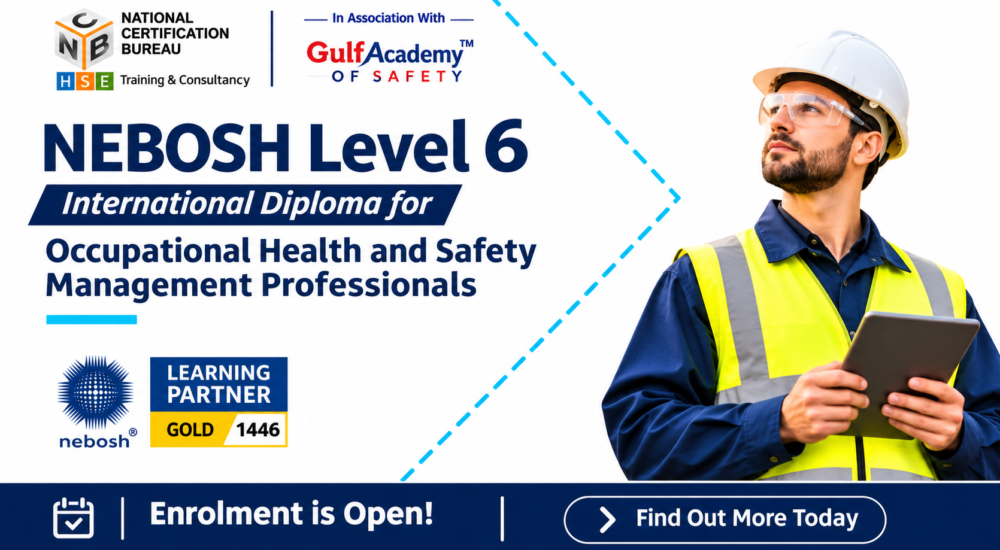


Advanced international qualification · RQF Level 6
Develop advanced occupational health and safety expertise, strengthen strategic leadership capabilities and progress towards senior HSE management responsibilities.
Qualification at a glance
Qualification facts reflect NEBOSH's published information for the 2023 specification, reviewed October 2026. Please refer to the official NEBOSH qualification page for the latest details.
About the qualification
The NEBOSH Level 6 International Diploma for Occupational Health and Safety Management Professionals is NEBOSH's advanced professional qualification for people who are, or intend to become, occupational health and safety practitioners. It is regulated by Ofqual at Level 6 of the Regulated Qualifications Framework (RQF) and carries 42 credits, placing it at the same academic level as a UK bachelor's degree, while remaining a vocational, practice-focused qualification.
The Diploma is designed to move learners beyond understanding hazards and controls towards advising organisations: interpreting legal and international frameworks, shaping policy, influencing leaders, analysing complex risks and recommending proportionate, justified solutions. Its structure follows a “Know” and “Do” approach. Unit DI1 builds the principles of health and safety management, while Units DI2 and DI3 apply that knowledge to the control of workplace health and workplace safety issues.
The qualification builds directly on foundation-level learning such as the NEBOSH International General Certificate (IGC). Where the IGC equips learners to identify hazards and support risk control, the Diploma develops the depth needed to evaluate management systems, investigate root causes, interpret monitoring data and lead continual improvement across an organisation.
Because it is written for an international audience and references International Labour Organization (ILO) conventions and recognised international good practice, the Diploma is applied across sectors including oil and gas, petrochemicals, construction, manufacturing, utilities, logistics, healthcare and the public sector. For HSE practitioners in Kuwait and the wider GCC, it offers a respected route to developing strategic competence and progressing towards senior HSE responsibilities.
Why choose the Diploma
A respected professional qualification that develops technical depth, sound judgement and the confidence to advise on serious organisational risks.
An Ofqual-regulated RQF Level 6 qualification from NEBOSH, the UK awarding body whose qualifications are widely valued by employers worldwide.
Covers law and enforcement, human factors, occupational hygiene, toxicology, process hazards, machinery, fire and construction at professional depth.
Develops the ability to influence senior management, build a business case, negotiate and lead organisational change.
Supports progression towards senior adviser and management roles, and on successful completion entitles holders to use the letters IDipNEBOSH.
Applies qualitative, semi-quantitative and quantitative risk techniques, loss-causation models and performance monitoring to real problems.
Explores just culture, worker consultation, Safety I and Safety II thinking and behavioural change to create lasting improvement.
NEBOSH states the Diploma meets the academic requirements to apply for IOSH membership at the appropriate grade. IOSH and other professional bodies set and apply their own full criteria.
Internationally framed content applies to oil and gas, construction, manufacturing, logistics, healthcare and public-sector environments.
Who should attend
The Diploma suits practitioners who already work in, or are moving towards, roles that advise organisations on health and safety.
The Diploma is demanding and assumes foundation knowledge comparable to the NEBOSH International General Certificate. If you are unsure whether your background is suitable, the NCB team can talk you through the entry guidance before you commit.
Ask NCB for guidanceDetailed course syllabus
Select any syllabus topic to read a summary. Element numbering follows NEBOSH's 2023 specification; the descriptions are original summaries prepared by NCB.
Unit DI1 · Know
Strategic management, leadership and international frameworks
Unit DI1 establishes the principles that underpin effective occupational health and safety management. Learners examine how law, enforcement, international conventions, insurers and stakeholders shape organisational behaviour; how leadership, culture and human factors influence performance; and how risk is identified, evaluated, monitored and reviewed. The unit also develops the professional skills a practitioner needs to advise, persuade and lead change.
Socio-legal models and the role and limits of legislation; goal-setting versus prescriptive law; principles of enforcement; the UN and the International Labour Organization, including conventions C155 and C187; non-governmental bodies, standards, media, reputation and supply-chain expectations; duties to third parties; and the influence of insurers and claims handling.
The organisation as a system; structures, functions and conflicting goals; internal and external influences on health and safety management arrangements.
Transformational, transactional, authentic and resonant leadership; leader attributes; worker consultation and participation based on ILO C155/R164 and recognised good practice.
Culture and climate and how to measure them; indicators of culture; blame and just culture; behavioural change programmes; traditional and proactive approaches including Safety I, Safety II, Safety Differently, human and organisational performance (HOP) and learning reviews.
Perception of danger and perceptual distortion; classification of human failure; skill-, rule- and knowledge-based behaviour; job, individual and organisational factors; improving human reliability.
Competence versus training; when training is needed; specific worker groups; supervision and information; characteristics and lessons of high-reliability organisations.
Hazard identification techniques including task analysis and HAZOP; qualitative, semi-quantitative and quantitative risk assessment; dynamic risk assessment; selecting controls; acceptability of risk; organisational risk profiling and integrating health and safety into business risk management.
Loss-causation theory, multi-causality and Reason's model; root-cause tools such as 5-Whys, fishbone, fault-tree, event-tree and bowtie analysis; loss-rate calculations and the limitations of incident and ill-health data.
Active and reactive monitoring; leading and lagging indicators; audits, inspections, safety tours, surveys and behavioural observation; benchmarking; formal and informal performance review and continual improvement.
The role of the health and safety professional; ethics; communication, influencing and negotiation; financial justification and cost–benefit analysis.
Economic and political influences, globalisation and migrant workers; corporate social responsibility and its benefits; the need for managed change and principles of change management.
Selecting and controlling contractors; focal companies and supply-chain management; ethical concerns including modern slavery.
Unit DI2 · Do
Occupational health, hygiene and the prevention of work-related ill health
Unit DI2 equips learners to recognise, evaluate and control health risks at work. It combines occupational health practice with occupational hygiene, enabling learners to assess exposure to chemical, biological and physical agents, interpret monitoring results, and recommend practical controls that protect both physical and mental health.
Occupational health specialists and services; fitness for work; reasonable adjustments, return to work and vocational rehabilitation.
Causes and control of work-related stress and mental ill-health; wellbeing strategies; work-related violence and aggression; risks and controls for lone workers.
Health assessment versus surveillance; surveillance for noise and vibration; biological monitoring; shift work; alcohol and drugs at work.
Body systems and target organs; routes of entry; inhalable and respirable dust.
Classification and labelling under GHS; safety data sheets; chemical risk assessment and control of exposure.
Types of epidemiological study; toxicological testing; dose–response relationships and related terms.
Identification and likely locations of asbestos; specialist controls and surveillance for asbestos and lead.
Dilution ventilation; local exhaust ventilation design, components and testing; respiratory, skin and eye protection; PPE selection, maintenance and training.
Workplace exposure limits; monitoring strategies, personal and static sampling; time-weighted averages; interpreting occupational hygienist reports.
Types, sources and properties of biological agents; transmission; hygiene and control measures.
Noise concepts and measurement; effects on hearing; noise risk assessment; hierarchy of control and hearing protection.
Hand-arm and whole-body vibration; exposure assessment; practical controls.
Ionising and non-ionising radiation; the electromagnetic spectrum; routes and health effects; risk assessment and controls.
The musculoskeletal system; work-related upper limb disorders; manual handling assessment and assessment tools; ergonomic controls including display screen equipment.
Thermal comfort; heat stress and the WBGT index; cold environments; thermal controls; welfare facilities; considerations for pregnant workers.
Unit DI3 · Do
Engineering controls, high-risk activities and operational safety
Unit DI3 develops the ability to advise organisations on common workplace safety issues and hazards, including how they can be assessed and controlled. It covers the physical and technical risks typical of high-hazard industries, from confined spaces and fire and explosion to machinery, lifting, electrical work, construction and workplace transport.
Safe places of work, access and egress; safety signs; lighting levels and their effects on safety and health.
Meaning and examples of confined spaces; hazardous atmospheres; risk assessment, safe systems of entry, permits and emergency arrangements.
Flammable materials, combustion and explosion mechanisms, ignition sources and process safeguards.
Fire risk assessment; detection and protection systems; means of escape; emergency and evacuation planning.
Hazardous chemical processes; storage and transport of dangerous substances; hazardous area precautions; major-accident prevention and emergency preparedness.
Planned preventive maintenance; isolation; inspection and testing regimes; equipment reliability.
Selection and suitability of work equipment; operating safeguards; hazards and controls for pressure systems.
Mechanical and non-mechanical hazards; machinery risk assessment; guards and protective devices; safety-related controls across the machine lifecycle.
Mobile plant hazards; lifting equipment and accessories; planning and controlling lifting operations; inspection requirements.
Electrical hazards; protective systems; safe working on or near electrical systems; fixed and portable equipment.
Coordination of construction work; excavation and demolition; prevention of falls and falling objects; working at height.
Vehicle and pedestrian segregation; traffic routes; driver competence, fatigue and journey management.
Assessment structure
There are no traditional written examinations. Each unit is assessed by a digital assignment or case study that tests how you apply your knowledge to realistic workplace situations.
| Unit | Assessment type | Assessment information | Submission window | Expected effort |
|---|---|---|---|---|
| DI1 | Assignment (two papers) | Workplace health and safety principles | 4 weeks (20 working days) | ≈ 40 hours |
| DI2 | Case study | Controlling workplace health issues | 2 weeks (10 working days) | ≈ 20 hours |
| DI3 | Case study | Controlling workplace safety issues | 2 weeks (10 working days) | ≈ 20 hours |
NEBOSH publishes fixed release and submission dates for each unit. Assessments are released and must be submitted at 12:00 noon UK time. Learners register through their Learning Partner before the relevant window.
All submissions are checked with plagiarism-detection software, and learners take part in a closing interview after each assessment to confirm the work is their own.
Results are notified 50 working days after the submission date. A unit certificate follows for each passed unit, and the qualification parchment is issued after the third unit is passed.
Units may be taken in any order. The enrolment period is five years from enrolment, or from the declaration of the first successful unit, whichever is later.
The provisional pass mark is 50% for each unit, and all three units must be passed. The overall grade is based on the sum of the three unit percentage marks.
Current release and submission dates are published on the NEBOSH qualification page.
Entry requirements
Completing the NEBOSH IGC first gives learners a working vocabulary of hazards, controls and management systems, so Diploma study time can be spent on analysis, evaluation and professional judgement rather than on fundamentals.
Course duration and study commitment
| Unit | Taught hours | Private study | Assessment | Total (TQT) | Credits |
|---|---|---|---|---|---|
| DI1 | 71 | 58 | 40 | 169 | 17 |
| DI2 | 60 | 45 | 20 | 125 | 13 |
| DI3 | 54 | 41 | 20 | 115 | 12 |
| Total | 185 | 144 | 80 | 409 | 42 |
NEBOSH's guidance indicates a minimum of 185 taught hours. As a guide, a full-time block course typically spans at least six weeks of taught study, and a part-time or day-release route at least 30 weeks; distance learning and eLearning are also permitted. The actual calendar duration depends on the delivery format, and NCB will confirm the options currently available for this qualification on enquiry.
Career opportunities
Holders of the Diploma commonly work in, or progress towards, senior advisory and leadership roles such as:
Lead the HSE function and management system for a site or business unit.
Provide expert advice on complex risks, compliance and improvement.
Integrate health, hygiene and safety programmes across operations.
Advise multiple clients on systems, audits and risk management.
Design and assure management systems, audits and performance metrics.
Direct HSE delivery on major projects and contracts.
Set strategy, policy and assurance across an organisation.
Executive HSE leadership, subject to substantial professional experience.
The Diploma strengthens the knowledge and credibility expected in these roles. Career progression also depends on experience, performance, employer requirements and the job market; no qualification guarantees employment, promotion or a particular salary.
Why study through NCB
National Certification Bureau is a Kuwait-based HSE training and consultancy organisation and a NEBOSH Learning Partner (Silver, No. 997).
A local team in Fahaheel, Kuwait, available to answer questions in your time zone.
Guidance on whether the Diploma suits your background, how it builds on the IGC and how to plan your study commitment.
Help with course enquiries, available study options, fees and the registration process.
Offered in association with Gulf Academy of Safety, a NEBOSH Learning Partner (Gold, No. 1446).

NEBOSH Learning Partner status identifies organisations approved by NEBOSH; it does not mean NEBOSH has endorsed this website or brochure. Delivery, assessment and course arrangements for this specific qualification, including which partner organisation enrols learners, will be confirmed by NCB before enrolment.
Frequently asked questions
Twelve common questions about the Diploma, its assessment and how to enquire through NCB.
Ask another questionIt is NEBOSH's advanced professional qualification for occupational health and safety practitioners, officially titled the NEBOSH Level 6 International Diploma for Occupational Health and Safety Management Professionals. It is regulated by Ofqual at RQF Level 6, carries 42 credits and consists of three units: DI1, DI2 and DI3.
Yes. NEBOSH is a UK awarding body whose qualifications are taken in many countries, and the Diploma is written for an international audience. NEBOSH also lists recognition routes with professional bodies such as IOSH, BCSP and BCRSP. Individual employers and professional bodies decide how they use the qualification.
HSE officers, engineers, advisers, supervisors and managers, consultants, and operations or project managers who want to develop professional-level competence or move into senior HSE roles.
No. There are no mandatory formal entry qualifications. However, NEBOSH strongly recommends prior learning at IGC level or an appropriate equivalent, because the Diploma assumes that knowledge.
Three: DI1 Workplace Health and Safety Principles, DI2 Controlling Workplace Health Issues, and DI3 Controlling Workplace Safety Issues. All three must be passed to achieve the Diploma, and they can be taken in any order.
DI1 is a two-paper assignment combining simulation questions with workplace activities, reflective tasks and a research project, submitted within a four-week window. DI2 and DI3 are scenario-based case studies, each submitted within a two-week window. Work is checked for plagiarism and each assessment is followed by a closing interview. The provisional pass mark is 50% per unit.
Total qualification time is 409 hours: a minimum of 185 taught hours, 144 recommended self-study hours and around 80 hours of assessment work. Calendar duration depends on the study format.
Yes. NEBOSH permits flexible delivery including part-time, day-release, distance learning and eLearning through Learning Partners. Please ask NCB which formats are currently available.
The Diploma supports progression towards roles such as HSE Manager, Senior Safety Advisor, HSE Consultant and Corporate HSE Manager. Outcomes also depend on experience and employer requirements; no qualification guarantees a job or promotion.
Yes. Its content on process safety, fire and explosion, confined spaces, hazardous substances, lifting and permit-controlled work is highly relevant to oil, gas and petrochemical operations, while remaining applicable to other industries.
Learners receive a NEBOSH unit certificate for each unit passed and, once all three units are passed, the NEBOSH qualification parchment showing the overall grade of Pass, Credit or Distinction. Holders may use the letters IDipNEBOSH.
Email info@ncbme.com or visit www.ncbme.com. The NCB team will confirm availability, study options, fees, entry guidance and the registration process before you enrol.
Enquiry and registration
Take the next step in your professional development. Contact the National Certification Bureau for information about available study options, qualification requirements, course fees and registration.